
Book Accessible Medical Housing Near Moffitt: A Step-by-Step Guide
Table of Contents
Understanding Accessible Medical Housing Requirements ADA-Compliant Features to Verify Why Proximity to Moffitt Matters
ADA-Compliant Features to Verify
Why Proximity to Moffitt Matters
Step 1: Assess Your Housing Needs and Timeline
Step 2: Verify ADA-Compliant Short-Term Rentals Questions to Ask Before Booking
Questions to Ask Before Booking
Step 3: Explore Pet-Friendly Medical Housing Options
Step 4: Compare Month-to-Month Furnished Apartments What to Expect in Fully Furnished Units
What to Expect in Fully Furnished Units
Step 5: Coordinate with Insurance and Medical Providers
Step 6: Secure Your Booking and Prepare for Arrival Documentation and Move-In Checklist
Documentation and Move-In Checklist
Common Mistakes to Avoid When Booking Medical Housing
Last Updated: August 29, 2026
Understanding Accessible Medical Housing Requirements
When traveling to a specialized medical center like Moffitt for treatment, your temporary housing becomes part of your recovery plan. Accessible medical housing means furnished, fully equipped temporary accommodations specifically designed to meet the needs of patients and their families during medical stays.
At Tanblu, we understand that patients recovering from procedures need more than standard short-term rentals. You need spaces where mobility challenges are anticipated, where accessibility isn't an afterthought, and where the environment actually supports healing rather than complicating it.
The difference between a regular furnished apartment and true accessible medical housing comes down to intentional design and verified accessibility features. This isn't about luxury, it's about removing barriers that could slow your recovery or create safety risks during a vulnerable time.
ADA-Compliant Features to Verify
The Americans with Disabilities Act (ADA) sets federal accessibility standards that legitimate medical housing should meet. However, not every rental claiming to be "accessible" actually follows these guidelines. Here's what genuinely matters:
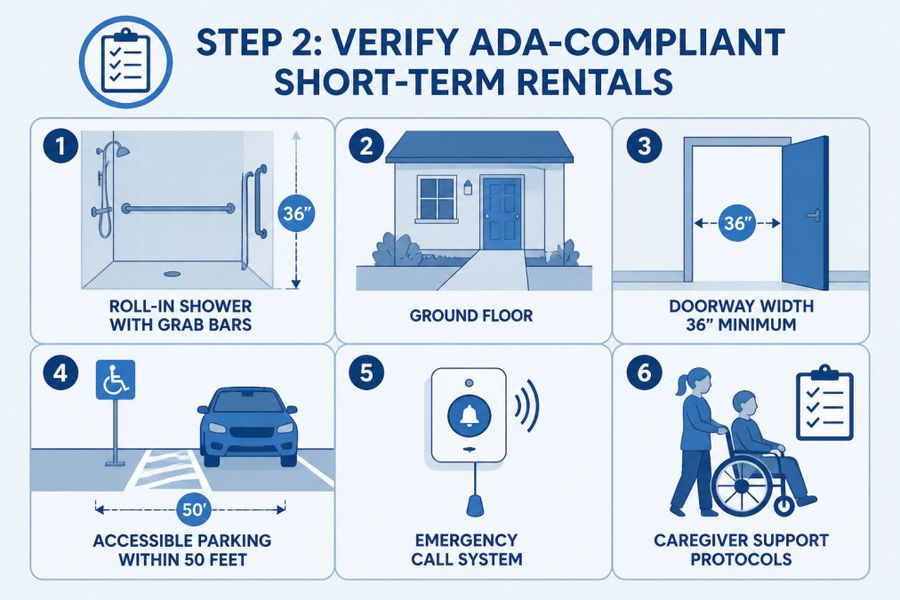
Roll-in showers are non-negotiable. A zero-threshold shower with grab bars positioned at 36 inches from the floor is the baseline (ada.gov). Ask for photos showing the actual shower configuration, not just a description.
Ground floor access eliminates the elevator gamble. Elevators break. Stairs become impossible. Ground floor units remove this variable entirely.
Doorway width matters more than you'd expect. ADA-compliant doors should be 36 inches minimum (ada.gov). Measure this yourself if possible, as landlords sometimes misreport dimensions.
Grab bars aren't decorative. They should be securely mounted at 33-36 inches from the floor, positioned beside toilets and in showers (ada.gov). Ask how they're mounted and request verification photos.
Accessible parking means designated spaces close to the building entrance. Confirm parking is actually available and within reasonable distance, not a theoretical spot somewhere in the lot.
Emergency protocols matter when you're recovering. Ask how the building handles medical emergencies, what communication systems exist, and whether staff are trained in patient assistance.
Why Proximity to Moffitt Matters
Moffitt Cancer Center is located in Tampa, and proximity isn't just about convenience, it's about medical continuity. Frequent appointments, unexpected complications, and follow-up visits mean you might need to return to the facility multiple times per week during certain treatment phases.
Living within 10-15 minutes of Moffitt reduces transportation stress during recovery. You're not spending energy navigating long drives when your body is already depleted. Shorter travel times also mean less sitting in cars, which matters for circulation and comfort during healing.
Step 1: Assess Your Housing Needs and Timeline
Before you start searching for accessible medical housing, get clear on what you actually need. This prevents wasting time on options that won't work and helps you communicate clearly with landlords and housing platforms.
Start with your treatment timeline. Are you coming for a single procedure with a two-week recovery or a three-month chemotherapy protocol? Your answer determines everything about how you should search.
Next, assess your mobility needs honestly. Can you navigate stairs with assistance, or do you need ground floor only? Do you use a wheelchair, walker, or cane? Will you need grab bars in the bathroom? Don't minimize these questions; they directly determine which properties will actually work.
Consider your support system. Are you coming alone, with a spouse, with adult children? Will your caregiver need their own bedroom or will you share? Tanblu's pet-friendly suites, for example, accommodate families who want to bring emotional support animals during recovery.
Budget matters, though it's often more flexible than you think. Insurance companies frequently cover temporary housing during medical treatment, but only if you book through verified providers and follow their documentation requirements. Ask your medical provider's patient advocate whether your insurance covers temporary housing and what their approved vendors list includes.
Start searching at least four to six weeks before your arrival date. Accessible units book quickly, and landlords need time to verify your needs, coordinate with insurance if applicable, and prepare the space.
Step 2: Verify ADA-Compliant Short-Term Rentals
Most people fail here. They find a listing that says "wheelchair accessible" and assume it's verified. Then they arrive and discover grab bars mounted in the wrong place, doorways that are too narrow, or parking that doesn't actually exist.
Verification requires asking specific questions, not accepting generic claims. Request floor plans and measurements. A legitimate accessible rental will have documented dimensions for doorways, hallways, and bathrooms. If a landlord can't provide these, move on.
Ask for photos of the actual accessible features, the shower configuration, grab bar placement, doorway width, and parking situation. Request recent photos (within the last month) so you know what you're actually getting.
Confirm ADA compliance in writing. Ask the landlord or property manager to confirm in email that the unit meets specific ADA standards. This creates a paper trail and signals that you're serious about verification.
Ask about recent guests with mobility needs. If the property truly serves medical patients, they'll have experience and can share feedback about accessibility.
Verify grab bar installation. Ask how grab bars are mounted (should be into studs, not just drywall) and when they were last inspected.
Confirm parking is reserved and accessible. Don't accept vague promises about "parking available." Get confirmation that a specific accessible parking space is reserved for your dates.
Ask about emergency protocols. How does the building handle medical emergencies? Is there 24/7 staff? Can they assist if you fall?
Step 3: Explore Pet-Friendly Medical Housing Options
Many patients rely on emotional support animals or service animals during medical treatment. A standard rental that bans pets forces an impossible choice: leave your animal at home during the time you need it most, or break your lease agreement.
Pet-friendly medical housing exists, but it's not common. Tanblu's approach is different: pet-friendly suites are designed to accommodate your animals as part of your support system, not as a burden.
Ask about pet policies upfront. Some properties allow cats but not dogs. Others allow dogs under 25 pounds. Service animals are federally protected and must be allowed, but emotional support animals have less legal protection; confirm this in advance.
Ask whether pet fees are included in the advertised price or added on top. Tanblu includes pet accommodations in the quoted rate, which means no surprise fees when you book.
Confirm the space is actually pet-friendly. This means a yard or nearby green space for dogs, not just a policy that allows them. Ask whether the property has outdoor space where your pet can exercise safely.
Ask about veterinary resources in the area. If your pet gets sick during your stay, you need to know where the nearest emergency vet is.
Step 4: Compare Month-to-Month Furnished Apartments
Medical stays often have uncertain timelines. You might expect to be in Tampa for two months but end up needing three. Month-to-month leases eliminate the penalty for uncertainty.
Get the lease terms in writing before you commit. Specifically, confirm:
Can you leave after one month with no penalty?
If you stay longer than anticipated, can you extend month-to-month indefinitely?
What happens if you need to leave early due to medical complications?
Are there any automatic renewal clauses that lock you in?
Furnished apartments should include basics: bed, couch, dining table, kitchen essentials (plates, glasses, cookware), and bedding.
What to Expect in Fully Furnished Units
A truly furnished unit for medical guests should include:
Kitchen essentials: pots, pans, plates, bowls, glasses, utensils, cutting board, knives, can opener, and basic appliances (microwave, coffee maker).
Bedding: sheets, pillows, blankets, and mattress protectors. Confirm thread count and that everything is clean and new.
Bathroom basics: shower curtain, towels, toilet brush, and trash can.
Living room furniture: couch, chairs, coffee table, and television.
Washer and dryer: essential for multi-week stays. Confirm they're in-unit, not shared laundry facilities.
Climate control: reliable air conditioning and heating. Temperature regulation affects sleep and pain management during recovery.

Step 5: Coordinate with Insurance and Medical Providers
Insurance coverage for temporary medical housing exists but requires navigation. Your insurance company won't automatically pay; you have to request it, document it, and often prove the housing is medically necessary.
Start by calling your insurance company's patient assistance or benefits line. Ask specifically: "Does my plan cover temporary housing during medical treatment?" Get the answer in writing or take detailed notes with the representative's name and date.
If coverage exists, ask for their approved vendor list. Booking through an approved vendor means faster reimbursement and no surprise denials. Tanblu works with insurance companies on medical housing arrangements; confirm whether your insurer has a relationship with them.
Ask about documentation requirements. Insurance companies typically need:
A letter from your medical provider stating that temporary housing is medically necessary
Proof of the housing cost (lease agreement or invoice)
Proof of payment
Dates of stay
Get this documentation before you book. Ask about reimbursement timing and any coverage limits. Some insurance plans cover housing only up to a certain dollar amount per night or only for the patient, not caregivers.
If your insurance doesn't cover housing, ask about other resources. Many hospitals have patient assistance programs or partnerships with housing providers that offer discounted rates for medical guests. Your medical provider's patient advocate is your best resource here.
Step 6: Secure Your Booking and Prepare for Arrival
Once you've found the right property, verify a few critical details before finalizing.
Confirm the exact move-in date and time. Ask whether early check-in is available if your flight arrives before standard check-in time. Ask about late check-out on your departure date if you have an afternoon flight.
Get written confirmation of all accessibility features you verified. The email confirmation should list: ground floor access, roll-in shower with grab bars, doorway widths, accessible parking space number, emergency protocols, and any pet accommodations.
Ask about the key pickup process. Will you get physical keys, a keypad code, or a smart lock? If you have mobility challenges, a smart lock is far easier than managing physical keys.
Confirm utilities and what's included. Is water, electric, gas, internet, and trash included in your rent? Get clarity so you're not without utilities on move-in day.
Documentation and Move-In Checklist
Before you arrive, create a folder with:
Lease agreement (signed copy)
Insurance documentation and pre-authorization letter
Medical provider's letter stating housing is medically necessary
Property contact information and emergency numbers
Photos of the property condition taken on move-in day
List of all accessibility features confirmed in writing
Parking space assignment confirmation
Utility account information (if applicable)
Pet documentation (vaccination records, registration)
Emergency contact information for your medical team
On move-in day:
Take photos of the entire unit to document condition
Test all accessibility features (grab bars, doorway widths, shower access)
Confirm parking space is accessible and reserved
Test emergency call system if available
Confirm internet is working
Locate circuit breaker, water shut-off, and thermostat
Get landlord contact information and after-hours emergency number
Common Mistakes to Avoid When Booking Medical Housing
Trusting "accessible" without verification is the biggest mistake. A landlord can claim accessibility without actually meeting ADA standards. Verification prevents this. Ask for photos, measurements, and written confirmation.
Booking too close to your arrival date limits your options. Accessible units book quickly. Start searching at least four to six weeks in advance.
Underestimating your accessibility needs creates problems. Be honest about your limitations during recovery, not your baseline health. This determines which properties will actually work.
Ignoring insurance coordination costs money. If your insurance covers housing and you don't go through the pre-approved vendor, you might pay out of pocket and struggle to get reimbursed.
Booking without written lease terms creates disputes. Get the lease terms in writing before you commit.
Forgetting about utilities and setup delays means you arrive without internet or functioning water. Confirm what's included in rent and what requires setup.
Not documenting the unit's condition on move-in creates liability disputes. Take photos on day one showing the condition. If the landlord later claims you damaged something, you have proof you didn't.
Choosing based on price alone ignores what you're actually getting. Tanblu's pricing depends on quantity, dates, and delivery, and reflects what's actually included: fully furnished, accessible, pet-friendly accommodations with utilities and support built in.
Booking accessible medical housing near Moffitt doesn't have to be stressful when you know what to verify and how to coordinate with insurance. The key is starting early, asking specific questions about accessibility, and getting everything in writing. Tanblu specializes in exactly this scenario, fully furnished, ADA-compliant temporary housing with month-to-month flexibility and built-in support for medical guests. Browse and book now to secure your recovery space before your treatment date arrives.
Frequently Asked Questions
What specific accessibility features should I look for in accessible medical housing?
Prioritize roll-in showers with grab bars, accessible bathroom layouts, ground floor access or elevators, wheelchair-accessible doorways (minimum 32 inches), accessible parking, and emergency support protocols. Verify these features directly with the property before booking. Ask the provider for photos or virtual tours of the bathroom and bedroom to confirm the layout meets your mobility needs.
How do I verify if a rental is truly ADA-compliant before booking?
Request detailed accessibility documentation from the property manager, including floor plans and photos of bathrooms, doorways, and parking areas. Ask specific questions about grab bar placement, shower design, and emergency protocols. Schedule a video walkthrough or visit in person if possible. Contact the property's management directly rather than relying solely on online descriptions. Verify that any accessibility claims are backed by recent photos and specific measurements, not just generic labels like 'wheelchair accessible.'
Can I book pet-friendly medical housing on a month-to-month lease without early termination penalties?
Many pet-friendly medical housing providers offer flexible month-to-month leases designed for temporary stays. Confirm the exact terms in writing before booking, including whether early departure incurs fees and how pet deposits are handled. Always clarify pet policies upfront, including breed restrictions, weight limits, and whether pet fees are included in the advertised monthly rate or charged separately.
Will my insurance company reimburse me for temporary medical housing near Moffitt?
Insurance coverage for temporary medical housing varies by policy and carrier. Contact your insurer before booking to confirm coverage limits, approved housing types, and required documentation. Many insurers require pre-approval or direct billing arrangements with the housing provider. Request an itemized invoice and proof of occupancy dates from your rental provider to submit with reimbursement claims. Work with providers experienced in insurance coordination to streamline the approval process and avoid out-of-pocket costs.
Browse and Book Now!
This article was written using GrandRanker


Comments