
What to Expect From Corporate Housing
Table of Contents
What Corporate Housing Actually Is
What Is Included in a Furnished Corporate Apartment
Corporate Housing vs Extended Stay Hotels: Key Differences
Corporate Housing Lease Requirements and Terms
Who Uses Corporate Housing and Why
Cost Factors, Pricing, and What Affects Your Monthly Rate
Moving In: Check-In, Setup, and What to Know About Security
Conclusion
Last Updated: August 27, 2026
What Corporate Housing Actually Is
Corporate housing is fully furnished, temporary residential accommodation designed for business professionals, relocating families, and individuals needing short-term housing solutions (peer-reviewed research). Unlike traditional apartments or hotels, corporate housing blends home comfort with lease flexibility, typically ranging from 30 days to several months. These units arrive turnkey ready: furniture, kitchenware, bedding, utilities, and high-speed internet included from day one.
The key distinction is flexibility combined with completeness. Whether you're relocating for a new job, recovering from a home disaster, traveling for medical treatment, or managing a corporate assignment, corporate housing solves the temporary relocation problem without long-term commitment. You get stability and a real home environment, not just a room and a bed, with predictable monthly rates and no year-long lease obligation.
Pro Tip The real advantage of corporate housing versus other temporary solutions is the combination of move-in readiness and lease flexibility. You don't negotiate utilities, buy furniture, or commit to a year. That's the whole point.
What Is Included in a Furnished Corporate Apartment
When you rent a furnished corporate apartment, you're getting far more than walls and a roof. The unit arrives fully equipped with everything required for daily living.
Standard inclusions typically encompass:
Furniture: Bedroom sets, living room seating, dining table and chairs, desks or work-from-home setups
Kitchen essentials: Appliances (refrigerator, stove, dishwasher), cookware, dishes, utensils, glassware, and food storage containers
Bedding and linens: Sheets, pillows, blankets, towels, and bath linens
Housewares: Pots, pans, cutting boards, kitchen tools, trash cans, and basic cleaning supplies
Utilities: Water, electricity, gas, and trash service included in rent
Internet and cable: High-speed internet and cable television access
Climate control: Heating and air conditioning maintained and functional
Many corporate housing providers, including Tanblu, go beyond basics. Pet-friendly suites accommodate your animals without surprise fees. Work-from-home setups include proper desks, ergonomic chairs, and reliable connectivity. Some units feature in-unit or building-accessible laundry facilities. Housekeeping services and concierge support are sometimes available.
The difference between "furnished" and "corporate furnished" matters. A basic furnished rental might include a bed and couch. Corporate housing means the apartment functions as a complete, professional living environment from arrival.
Key Takeaway The comprehensiveness of corporate housing, everything included, nothing to buy, is why it's faster and less stressful than piecing together temporary housing yourself.
Corporate Housing vs Extended Stay Hotels: Key Differences
Corporate housing and extended stay hotels both serve temporary residents, but they operate on fundamentally different models.
Extended stay hotels are hotel rooms with extended booking options. You rent a room, not an apartment. The space is smaller, designed for one or two people, and lacks the full kitchen and living areas of corporate housing. Housekeeping visits regularly, front desk staff manage check-ins, and hotel policies apply.
Corporate housing is an actual apartment or house rented on a short-term basis. You have full autonomy: your own kitchen, living room, bedroom, and often multiple rooms. No housekeeping unless you arrange it separately. You're renting residential space, not hotel service.

The practical differences:
Aspect | Corporate Housing | Extended Stay Hotels |
Space | Full apartment/house | Single hotel room |
Kitchen | Full kitchen | Kitchenette or none |
Utilities Included | Yes, typically | Varies; often extra |
Lease Terms | Flexible, 30+ days | Night-by-night or weekly |
Housekeeping | Optional or self-managed | Daily or scheduled |
Pet Policy | Often pet-friendly included | Restricted; extra fees common |
Work Setup | Dedicated desk/office space | Limited desk area |
Monthly Cost | More economical long-term | Higher per-day rate |
Extended stay hotels win if you need hotel-style service or a short 1-2 week stay. Corporate housing wins if you value space, privacy, a full kitchen, and cost efficiency over multiple months. For a three-month assignment, corporate housing typically costs significantly less than extended stay hotels (bls.gov). The flexibility difference is crucial: corporate housing leases are month-to-month with no long-term commitments, while extended stay hotels charge nightly rates that compound quickly.
Corporate Housing Lease Requirements and Terms
Corporate housing lease agreements differ substantially from traditional residential leases. They're designed for temporary occupancy with shorter terms, simpler requirements, and faster move-in processes.
Standard lease duration: Most corporate housing operates on a 30-day minimum commitment, with month-to-month renewal options. The month-to-month structure means you're not locked in. If your relocation completes early or your assignment ends, you exit without penalty (subject to proper notice, usually 30 days).
Security deposits and move-in costs: Corporate housing typically requires a lower security deposit than traditional apartments. Some providers waive deposits for corporate clients with verified employment or insurance coverage. Move-in costs usually include the first month's rent plus the deposit, with no additional fees for utilities, setup, or furnishings.
Lease agreement terms: The paperwork is simplified compared to traditional leases. You'll sign a short-term rental agreement specifying move-in and move-out dates, monthly rent and payment schedule, what's included, pet policy, cancellation notice requirements (typically 30 days), damage responsibility, and house rules.
Flexibility provisions: Most corporate housing leases include early termination clauses. If you need to leave before your lease ends, you provide written notice (usually 30 days) and exit. Some providers charge an early termination fee; others don't. Tanblu's month-to-month model means you're never trapped in a situation that no longer works.
Insurance and liability: Corporate housing providers typically carry property insurance. You're responsible for your personal belongings, so renters insurance is recommended. If your stay is covered by your employer or insurance company, verify that corporate housing qualifies under their coverage policies before signing.
Watch Out Don't assume all corporate housing offers the same flexibility. Some charge early termination fees or require 60-day notice. Read the lease carefully and confirm the cancellation terms match your actual timeline uncertainty.
Who Uses Corporate Housing and Why
Corporate housing serves multiple distinct populations, each with different needs and timelines.
Corporate travelers and business relocations: Employees transferring to new offices, executives on extended assignments, and teams managing temporary project work use corporate housing as a bridge between locations. The flexibility and included amenities make this far simpler than booking hotels or signing year-long leases.
Relocating families: Families moving for new jobs often use corporate housing as a temporary base while searching for permanent homes. They need space for multiple family members, a kitchen to cook, and residential comfort, not a hotel room. Month-to-month leases let them stay as long as house-hunting takes without committing to a permanent lease they might break.
Insurance-covered temporary housing: Individuals displaced by home disasters often have insurance coverage for temporary housing while their primary residence is repaired (fema.gov). Corporate housing qualifies under many insurance policies and works directly with insurers on billing and coverage verification.
Medical patients and recovery stays: People traveling for medical procedures or extended treatment need accommodation near hospitals or treatment centers. Corporate housing provides a stable, comfortable base for multi-week or multi-month recoveries. Families appreciate having a full kitchen, multiple rooms, and a home-like environment during stressful medical situations.
Remote workers and digital nomads: Professionals working remotely can relocate temporarily to different cities without signing leases. Corporate housing with reliable high-speed internet and work-from-home setups supports this lifestyle. The flexibility means they can stay three months, then move to the next location without penalty.
Real estate professionals and investors: Agents relocating for new markets, investors managing properties during transitions, and contractors working on extended projects use corporate housing for their temporary base. It's more professional and cost-effective than hotels for stays exceeding a few weeks.
Each group values different aspects: corporate clients prioritize billing simplicity; families want space and comfort; medical patients need reliability; remote workers need internet and flexibility. Corporate housing serves all these needs because it combines turnkey living with no long-term commitment.
Cost Factors, Pricing, and What Affects Your Monthly Rate
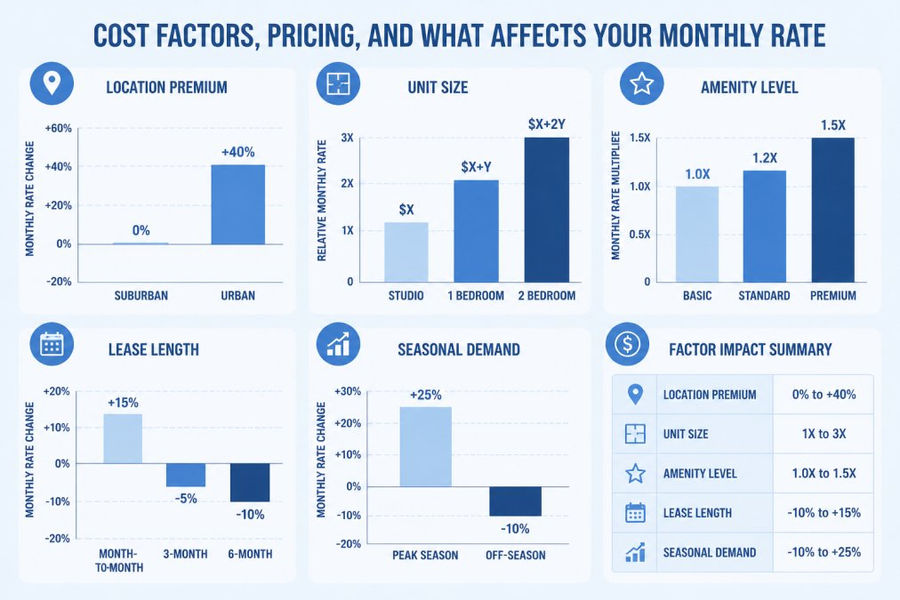
Corporate housing pricing depends on multiple factors. Understanding them helps you budget accurately and identify what drives costs.
Location and market: Urban centers and high-demand areas command higher monthly rates than suburban or smaller markets. Proximity to business districts, medical centers, transportation hubs, and amenities influences pricing.
Unit size and bedroom count: A studio or one-bedroom costs less than a two or three-bedroom unit. Don't overpay for extra bedrooms you won't use.
Amenity level: Basic furnished apartments cost less than luxury units with premium finishes, high-end appliances, or exclusive building amenities. Evaluate which amenities justify the cost for your situation.
Lease length: Month-to-month leases typically cost more per month than longer commitments. A three-month lease might offer a modest discount. Seasonal demand also affects pricing; peak relocation seasons (spring/summer) often run higher than winter.
Utilities and inclusions: Corporate housing typically includes utilities, internet, and furnishings in the quoted monthly rate. Some providers separate these costs; others bundle them. Clarify what's included before comparing prices.
Pet fees: Pet-friendly units sometimes include pets in the base rate (as Tanblu does), while others charge monthly pet fees on top. Confirm whether pets are included or additional.
Seasonal and promotional pricing: Off-season months may offer discounts. New properties sometimes offer move-in specials. Insurance-covered stays or corporate accounts might qualify for preferred rates.
For budgeting purposes, request a detailed quote that itemizes rent, utilities, internet, and any other charges. Tanblu's transparent pricing and included amenities simplify this, you know what you're paying for upfront.
Moving In: Check-In, Setup, and What to Know About Security
The move-in experience for corporate housing differs significantly from traditional apartments or hotels.
Pre-arrival coordination: Most corporate housing providers manage check-in appointments rather than offering 24-hour access like hotels. You'll coordinate your arrival date and time with the property management team. Arrive during business hours on your scheduled date.
Move-in walkthrough and inspection: Upon arrival, you'll walk through the unit with a property manager. They'll confirm that everything listed in your lease agreement is present and functional. You'll typically sign an inspection checklist documenting the unit's condition. Take photos or video for your records; this protects both you and the provider if disputes arise about pre-existing damage.
Keys, access codes, and security: You'll receive physical keys or digital access codes (or both). Some modern corporate housing uses smart locks with temporary codes that expire when your lease ends. Understand the security protocol: is there 24-hour security, key card access to common areas, or video surveillance?
Utility and internet activation: Utilities and internet should already be activated before you arrive. Test that water, electricity, heating/cooling, and internet are functioning during your walkthrough. Report any issues immediately; they're the provider's responsibility to fix.
Parking and vehicle registration: If the unit includes parking, you'll receive parking passes or assigned spaces. Understand the parking rules and whether permits are required.
Emergency contacts and maintenance requests: You'll receive a contact list for emergencies, maintenance requests, and property management. Understand how to report issues and what the expected response time is.
Security deposit and move-out procedures: Confirm the security deposit amount and how it's held. Understand the move-out inspection process: you'll typically schedule a final walkthrough where the property manager documents the unit's condition. Damage beyond normal wear-and-tear may be deducted from your deposit. Return all keys and access codes.
Pro Tip Take detailed photos and video during your move-in walkthrough. Document the unit's condition, any existing damage, and all included items. This protects you if the provider later claims you caused damage you didn't.
Security considerations: Corporate housing should meet basic security standards. Confirm that locks are functional, windows secure, and the building has controlled access. Tanblu prioritizes safety and security across its properties, ensuring guests feel protected in their temporary home.
Neighborhood orientation: The property manager can provide local information: grocery stores, pharmacies, restaurants, public transportation, and emergency services. This context helps you settle in faster and navigate your temporary location confidently.
Corporate housing bridges the gap between hotels and permanent housing, offering flexibility, completeness, and comfort for temporary relocations. Whether you're managing a corporate assignment, relocating your family, recovering from a disaster, or traveling for medical treatment, corporate housing eliminates the friction of temporary living. You get a fully furnished, move-in-ready home with included utilities, internet, and housekeeping options, no furnishing hassles, no long-term commitment, no surprise costs.
The month-to-month flexibility means your lease adapts to your actual timeline. If your assignment ends early or extends unexpectedly, you adjust without penalty. This adaptability, combined with transparent pricing and professional management, makes corporate housing the practical choice for temporary housing needs.
When you're ready to explore corporate housing options that prioritize your comfort and flexibility, [Tanblu offers fully furnished, pet-friendly suites(/post/pet-friendly-furnished-rentals-2026-review) with month-to-month leases designed for corporate travelers, relocating families, medical patients, and disaster recovery situations | tanblu.com]. Browse and book your temporary home today, move in with confidence, knowing everything you need is already there.
Frequently Asked Questions
Q: What does corporate housing include?
A: Corporate housing typically includes fully furnished units with kitchen essentials, bedding, housewares, cable television, and high-speed internet. Most properties offer utilities included in the monthly rate. Amenity packages vary by property but often feature work-from-home setups, and professional property management. The goal is turnkey living where you arrive to a move-in ready space.
Q: How long can you stay in corporate housing?
A: Corporate housing accommodates short-term leases with a 30-day minimum in most cases, though some properties offer even shorter terms for specific situations. Many providers offer flexible lease agreements with month-to-month options, allowing you to extend or exit based on your assignment duration. This flexibility makes corporate housing ideal for business travel, relocation periods, and temporary housing needs without the long-term commitment of a standard apartment lease.
Q: How does corporate housing differ from a standard apartment lease?
A: Corporate housing is specifically designed for temporary occupancy with flexible terms, typically 30 days to 12 months. Standard apartment leases usually require 12-month commitments and don't include utilities, furniture, or housekeeping. Corporate housing arrives fully furnished with amenities and professional management, while standard apartments require you to furnish and maintain the space yourself. Corporate housing also accommodates shorter stays and often works directly with corporate travel policies and insurance claims.
Q: Are utilities included in corporate housing costs?
A: Yes, utilities are typically included in corporate housing monthly rates. Most properties cover electricity, water, gas, internet, and cable television as part of the lease agreement. This all-inclusive approach simplifies budgeting and expense reporting for employees and makes it easier for companies to manage housing allowances. Always confirm the specific utilities included in your lease before signing, as some premium amenities or overages may incur additional charges.
Browse and Book Now!
This article was written using GrandRanker


Comments